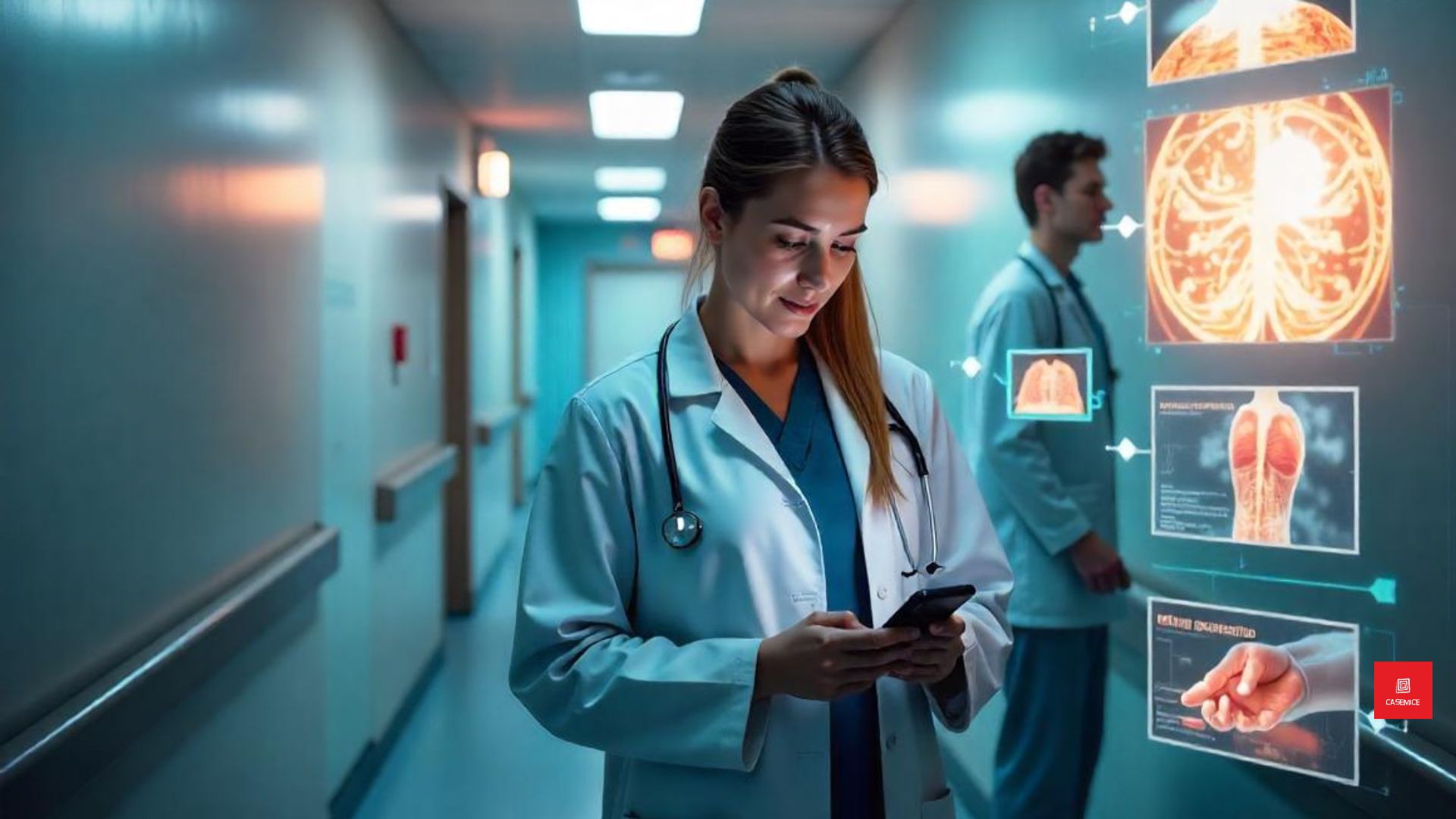
‘Case simulation ’ enables the patient to be visualized in the minds of physicians in the first stage, while in the second stage,it enables the target audience of this case to see how to approach such a patient.
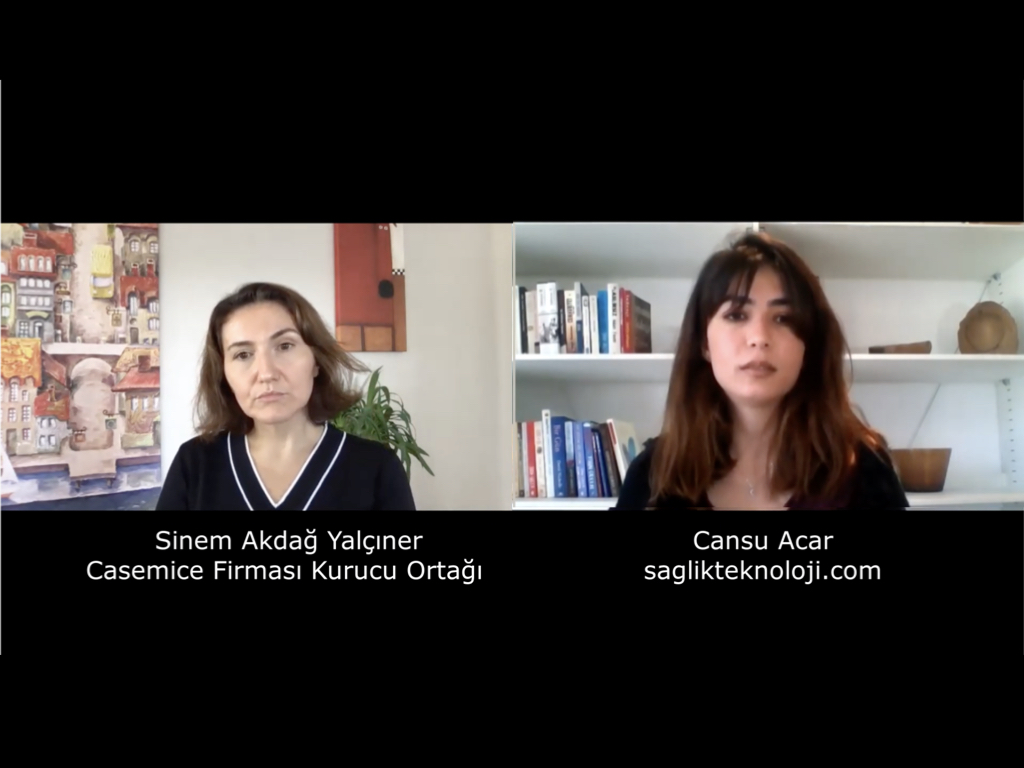
Ms. Sinem, can we get to know you first?
I am the founding co-partner of Casemice Company. We have been working actively since 2013. Our core focus is on case simulations. As two people who have worked in the pharmaceutical industry for many years, we started with the project DOCMAZE case simulation. In 7 years, we developed many case simulations in 5 different categories. While doing this, we have an office in Sakarya SciencePark where our software developers are located. We develop all our products and try new technologies there, and then the products reach clients with the help of our operations and marketing departments in the Levent office. We launch 2-3 new products every year.
Can you talk about simulation technologies in the field of health?
Simulation, by definition, is experiencing something in a virtual environment before experiencing it in reality. What let the audience to experience a patient case as if the case was encountered, thus reaching high levels of gain.
The patient is modeled first, which can be in many different areas. Think of rare diseases, those that physicians rarely see and often encounter with different indications. The physician normally encounters something that he will encounter with a probability of 1 in a million during the process from anamnesis to treatment, which provides advantages in many ways.
Could you tell us about the Casemobile application produced by your company?
We first planned Casemobile for abroad since iPad–based activities were applicable for Turkey but not for overseas. It was an atmosphere where we could not physically be found. Casemobile penetration is also high in Turkey. It is a platform that you can easily access, even from your mobile phone. Here is what our physicians do: Let’s say there is a patient case to be shared, a case of any hcp who wants to share it with other colleagues and get comments on it. Or it could be a patient case from a different country. We submit this patient case into the simulation; the case owner who will explain this case, without presenting anything, shares the link with physicians who are attending the activity. Physians start to analyze this case; they ask questions via the simulation, and the simulation answers as if it’s a real patient. After doing a physical examination, physicians may want needed analysis, and they may get the results of the analysis. It is as if our physician is experiencing all the steps s/he does while taking any patient to treatment.
Afterwards, if s/he encountered such a patient, what kind of approach s/he would show would be summited. Now, after this process, hcp, who prepared this case, will be able to see the approach of the physians who solved this case. On top of that, he can transfer his own approach and discuss this case with them.
Basically, the case simulation provides a very clear visualization of the patient case in the minds of physicians in the first stage, and if there is a person who will provide training about this case in the second plan, or if there is a person who wants to convey his experience, it enables the target audience to see how to approach such a patient. In the end, a very nice interactive activity with everyone’s achievement takes place. With the broadcasting of the physician’s video, live or offline, on a platform, the training totally completes itself.
This practice is being done in many countries, and we are getting a lot of praise from abroad, because the alternative is to present the case in PowerPoint. Today, we have so many stimuli that it is very difficult for us to give our full focus to a presentation for an hour and to perceive this case fully in every detail. This makes this work much more interactive and more effective.
What are the benefits and contributions of simulation applications in health?
The point where it works the most is that it is very useful in diagnosing diseases. Then the guidelines change, and there may be serious difficulties in the implementation of new guidelines, because modeling that patient is critical. Here, it is of great importance that the patient can be modeled and visualized very clearly in the physician’s mind. We can say that early diagnosis also benefits economically for many diseases. It may add one of the values that can prevent job loss. Or, a patient may seriously regain his health with early intervention. Apart from that, it has great benefits in terms of directing to more correct treatments. There are statistics like this: The medical error rate regarding this diagnosis and treatment is 22%. Now 22% is a serious rate. This is an area where they try to find a solution by working seriously. Ours touches exactly that too. There are many applications supported by artificial intelligence, but the data should be guided by the physician in order for the artificial intelligence to handle this job completely and to make a diagnosis. Until that point, our physicians should be equipped, and their knowledge transfer should be transferred more effectively. In that sense, simulation is very useful.
What would you say about simulation applications in health in the world?
While we started this work, of course, there were some simulations that we were inspired by. Patient case simulations are mostly used in universities. The aim of the simulation is not to prepare a more sharable case, but to improve graduates’ patient management skills. Of course, preparing cases for graduate students is much more difficult. The biggest advantage of ours is that it is very practical, and it is at a point where everyone can easily prepare their own case and share. In many studies abroad, we know that simulation is much more effective than normal education.
What are your predictions for the next years about the technology of this product and your company’s goals?
We are a company that closely follows new technologies. Our team in Sakarya SciencePark is focused on developing our existing products and on adding new technologies to our business. Currently, our artificial intelligence supported simulations are used very effectively. Our goal is to create the feeling that there is a real patient in front of the doctor who is talking to him. There are now many technologies such as virtual reality ( VR ) and augmented reality (AR) that we use for case simulation. For a technology to become widespread, it must be cheap and accessible to everyone. Artificial intelligence is a technology that can move very easily over the web. When we say VR, we are referring to the dissemination and the convenience of the content produced in it. There are a number of improvements made on Facebook. We also follow this technology to adapt to this. But we see our future in giant platforms. We hope that everyone will benefit while physicians will be able to create and share their own cases, their own groups and gain some knowledge from there.
What I call simulation is really important, and the more we get into it, the better we understand it. It is an essential part of education. I teach consumer behavior at Mimar Sinan University; the consumer behavior perspective is not just to make and sell a product. The main goal is to benefit from the product. Especially during the pandemic period, we have seen that case simulations are very useful in terms of getting people involved more and realizing clearer training. Our goal in the future is not only for people in Turkey; every medical student in the world will be able to benefit from Casemice case simulations when they graduate, so we are making this available around the world.
Source: http://www.saglikteknoloji.com/saglik-hizmetlerinde-simulasyon-teknolojileri/